Structures situated on the water—such as Ngoc Son Temple, the One Pillar Pagoda, Tran Quoc Pagoda, and Tay Ho Palace—have long been distinctive cultural landmarks of Hanoi. Soon, the Hanoi Opera House, located on the Quang An Peninsula, will emerge as a vibrant new icon for the city.
Renzo Piano, an Italian architect, is the visionary behind iconic structures such as the Centre Georges Pompidou in Paris and The Shard in London, as well as major works like The New York Times Building in New York and the Parco della Musica Auditorium in Italy.
Beyond his fame as an architect, Piano is renowned for design philosophies that honor cultural and historical values. For instance, he designed a children’s hospital in Uganda using materials like red clay, wood, sand, and gravel—materials that deeply moved him during his visit to the country.
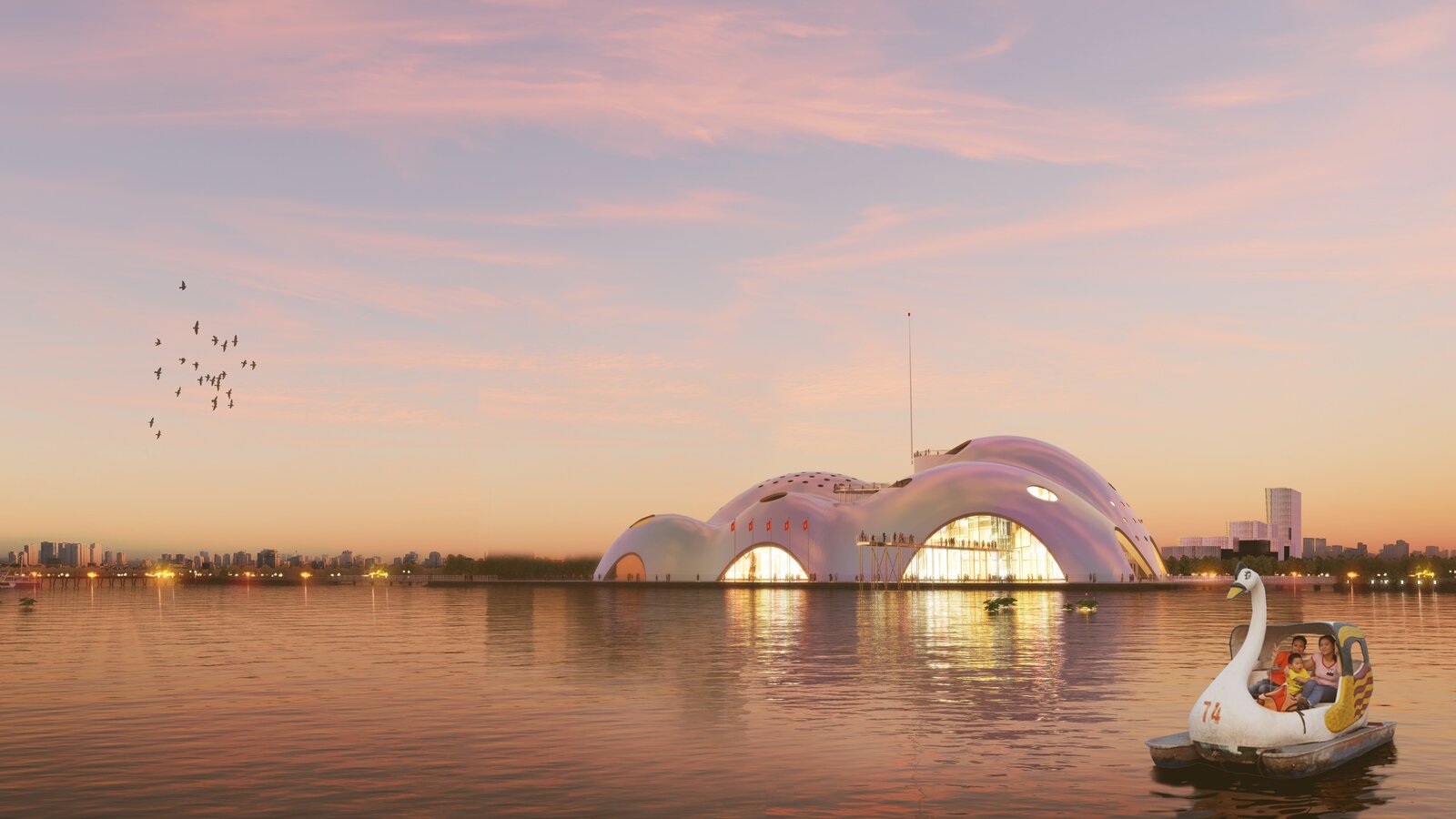
Captivated by the intrinsic beauty and traditional values rooted in the legends of West Lake—home to the ancient Tran Quoc Pagoda and the sacred Tay Ho Palace—Renzo Piano has infused the spirit of Hanoi into the opera house’s design. Its graceful dome mimics the ripples of the poetic West Lake, while its colors shift over time thanks to a shimmering pearlescent effect, creating an architectural icon that is both sophisticated and emotionally evocative.
Having spent 40 years researching thin-shell structural technology—a highly complex and intricate engineering feat—the architect, with 65 years of professional experience, aims to apply this cutting-edge technology to the dome of the Hanoi Opera House for the first time. The roof shell structure, ranging from 200 mm to 600 mm in thickness, represents the theater’s most unique technological feature. This design not only lends the structure an elegant, distinctive aesthetic but also optimizes acoustic quality for musical performances—a paramount requirement for world-class opera houses. The naturally curved dome—a striking, iconic visual feature—is the result of Renzo Piano’s in-depth research into biomimicry, drawing inspiration from the structural forms of bones, seashells, and bird skulls, as well as the vein patterns of floating water lily leaves.
Beyond its world-class roof structure, the theater incorporates numerous cutting-edge design technologies and techniques. The walls of the main auditorium are lined with a system of mechanically operated acoustic panels. These panels can be adjusted—opening, closing, and shifting vertically or directionally—to suit specific performance types, thereby ensuring optimal sound reflection, absorption, and reverberation times. This system is the first of its kind in Vietnam and is a feature found in very few theaters worldwide.
The theater’s primary functional spaces are seamlessly interconnected. If one were to draw a circle around each functional area and then erect a hemisphere upon it, the intersection of these hemispheres would form the shape of the roof shell. Every design detail has been meticulously calculated to maximize structural integrity, landscape harmony, and the artistic experience.

Renowned opera houses—such as the Sydney Opera House (Australia), La Scala (Italy), and the Royal Opera House (UK)—serve not merely as venues for artistic performance but as national icons, attracting millions of visitors annually to experience their cultural significance. In recent years, the Vietnamese public’s appreciation for the arts has reached new heights. While Vietnam’s century-old theaters have long served domestic productions, they have yet to become must-visit destinations for world-renowned figures in arts and culture. In contrast, the Hanoi Opera House—featuring an auditorium with over 1,800 seats (rivaling Singapore’s Esplanade) and state-of-the-art acoustics—is poised to elevate the performance landscape. It is ready to host international productions, thereby attracting global artists and enthusiasts alike.
We believe this magnificent structure adds significant cultural and artistic value—as well as tourism appeal—to the capital’s development. A beautiful landmark does more than just adorn the cityscape; it creates a powerful resonance that fosters comprehensive development—a goal the nation consistently strives to achieve.
With its unique characteristics and distinctive value, the Hanoi Opera House is more than just an architectural marvel; it is a cultural icon. It elevates Hanoi’s image from a historic city to a vibrant center of arts and culture that embodies the spirit of the modern era while converging the finest elements of global culture.

 07/09/2026
 02/06/2026

Alphahousing is the leading real estate leasing agent in Hanoi. We are a dedicated team of truly passionate, property professionals who understand our clients’ needs and wants.
No. 809, Vuon Dao Building, 689 Lac Long Quan, Tay Ho Dist, Hanoi.
Copyright 2025 | Alphahousing.vn. All Rights Reserved

 Vietnamese